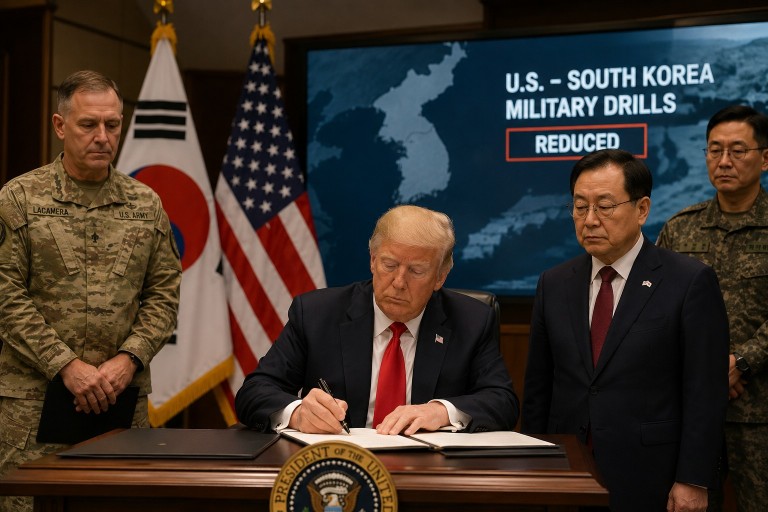
Amid ongoing diplomatic efforts with North Korea, U.S. President Donald Trump has instructed a significant reduction in the scope of joint military exercises with South Korea, citing the high costs and the message they send to Pyongyang. Trump attributed his decision to the positive rapport he claims to have with North Korean leader Kim Jong-un. The annual Ulchi Freedom Shield exercises, originally set to start on Monday and run until August 27, involve roughly 18,000 South Korean forces alongside U.S. troops and members from various United Nations Command states.
Although the drills could not be entirely canceled at this stage, Trump directed Defense Secretary Pete Hegseth to sharply reduce U.S. involvement. Nevertheless, South Korea’s defense ministry announced that the exercises would proceed as initially planned. This development arises despite warnings from U.S. and South Korean military officials that North Korea is accruing critical battlefield experience through its collaboration with Russia in the conflict in Ukraine. North Korea has reportedly dispatched over 14,000 troops to aid Russian forces, supplying them with artillery and ballistic missiles. These engagements are believed to be enhancing North Korea’s military prowess in modern warfare tactics, such as drone operations, GPS disruption, cyber warfare, and missile technologies.
U.S. military representatives have confirmed that the joint exercises with South Korea have been adjusted to counter these new threats. They caution that the skills North Korean troops are acquiring in Ukraine could bolster Pyongyang’s military strength upon their return. Trump’s history of scaling back major military exercises with South Korea in pursuit of diplomatic engagement with Kim Jong-un has stirred unease in Seoul. The current decision has reignited concerns over the strength of the U.S.-South Korea alliance and the region’s deterrence capabilities.
South Korean analysts have voiced apprehensions that the reduction of these drills might undermine military readiness and deterrence, offering only minimal diplomatic gains since North Korea traditionally demands the cessation of such exercises. North Korea has consistently condemned these military exercises as preludes to invasion, threatening to counteract with more robust military actions. In a show of defiance, Pyongyang has conducted ballistic missile tests leading up to the drills.
Despite Trump’s directive, South Korean authorities emphasize the continued importance of joint military exercises for preparing against the growing threat from North Korea’s increasingly sophisticated military capabilities. The ongoing tensions underscore the complex balance of maintaining military preparedness while navigating diplomatic relations in the region.