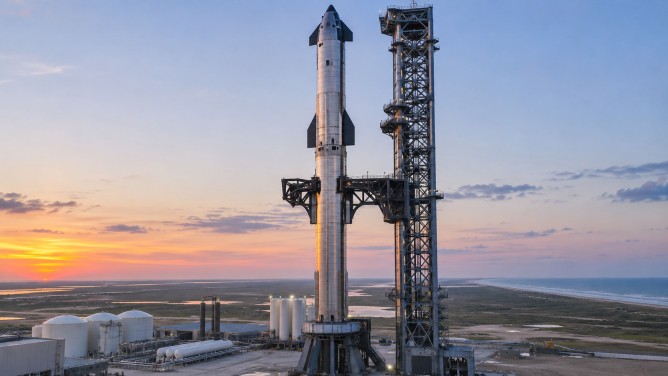
SpaceX is gearing up for a groundbreaking test flight of its Starship rocket, aiming to recover both stages of the massive 124-meter vehicle. This forthcoming mission, which will mark the 15th test flight of the Starship, seeks to catch both the Super Heavy booster and the Starship spacecraft using mechanical arms at the launch site. Achieving this would be a significant milestone in the development of fully reusable launch systems, a key goal for SpaceX as it works to reduce the costs and increase the frequency of space missions.
The mission is set to launch from SpaceX’s Starbase in southern Texas. The Super Heavy booster is expected to return to the launch site around six and a half minutes after liftoff, where it will attempt a landing using the giant mechanical arms known as chopsticks. SpaceX has successfully recovered the booster in this manner on three previous occasions. The major innovation in this test is the attempt to recover the Starship spacecraft using the same method for the first time.
Once in orbit, the Starship spacecraft will deploy 26 satellites into the Starlink internet network, completing approximately 22 hours in space and 14 orbits around Earth. It will then re-enter the atmosphere and attempt a controlled descent and landing between the mechanical arms. This phase of the mission poses significant technical challenges, as the spacecraft will be returning from a much greater altitude and at higher speeds compared to the booster.
Successfully recovering the Starship spacecraft would represent a major technological breakthrough. It would demonstrate the feasibility of fully reusable rocket systems, potentially revolutionizing space travel by making it more cost-effective and accessible. Additionally, the Starship is designed for various applications, including deploying satellites and supporting future crewed missions to the Moon and Mars.
Despite the ambitious goals, several engineering challenges remain, such as ensuring the spacecraft can withstand the extreme temperatures of atmospheric re-entry and developing in-orbit fuel transfer technology. These challenges must be addressed as SpaceX progresses towards using a version of the Starship as a lunar lander for NASA’s Artemis programme.
SpaceX has stated that the recovery operations will proceed only if conditions are suitable, and the test flight is pending final regulatory approval. The outcome of this test could have significant implications for the future of space exploration and SpaceX’s role in it.