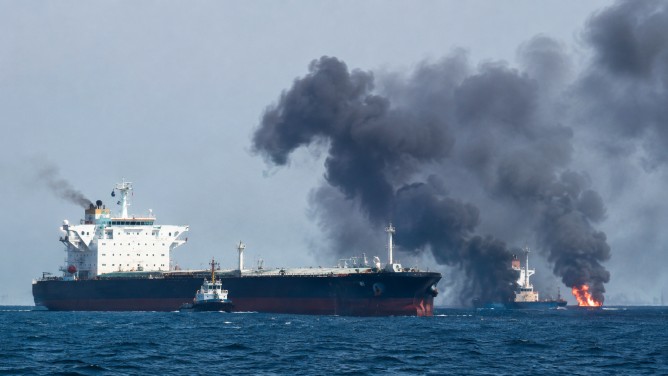
The Islamic Revolutionary Guard Corps (IRGC) of Iran announced that it had targeted two oil tankers in the Strait of Hormuz, alleging that the vessels, which were under U.S. military escort, did not adhere to its specified maritime route. Following this confrontation, the IRGC reported that four additional tankers reversed their course. This incident is part of the broader context of heightened tensions in the Strait of Hormuz, a crucial artery for global energy shipments, which have been significantly disrupted due to escalating hostilities between Iran and the United States. This flare-up has led to a notable decline in maritime activity and has pushed global crude oil prices beyond $90 per barrel.
Regional military tensions have shown no sign of abating. Kuwait reported successfully intercepting Iranian drones aimed at its critical military and strategic sites, managing to do so without any reported casualties. Meanwhile, in Lebanon, Israel executed a major offensive near Beaufort Castle, justifying the action as a strike against Hezbollah’s infrastructure. Lebanese authorities, however, accused Israel of violating the ceasefire agreement, further complicating the fragile situation in the region.
The ongoing conflict has prompted U.S. President Donald Trump to gather his cabinet at Camp David to evaluate the conflict’s progression and its economic ramifications. The surge in fuel and consumer prices is adding strain to the U.S. administration, which is facing dwindling public support for the conflict as indicated by recent opinion polls. The economic implications are becoming increasingly significant as the conflict stretches on.
Amidst this instability, major energy corporations are experiencing increased profits, driven by the sustained high oil prices affecting global markets. The prolonged uncertainty in the region continues to exert upward pressure on energy costs, reflecting the broader economic impact of the geopolitical tensions.