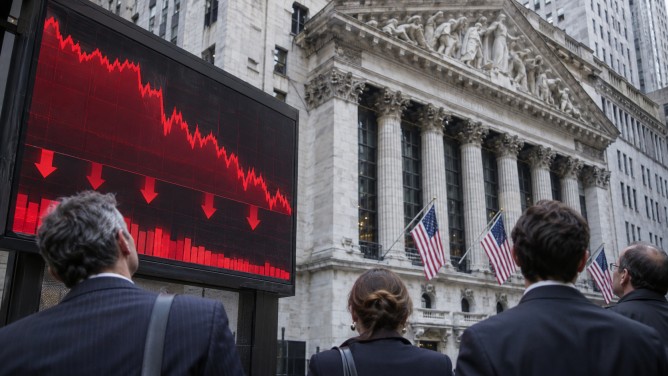
U.S. stock markets experienced a notable downturn on Thursday as investor concerns regarding valuations in the artificial intelligence sector led to widespread selling. The S&P 500, a key indicator of market performance, dropped by 2% to 7,175.83, extending its losing streak to six sessions, the longest in two and a half years. The Dow Jones Industrial Average suffered a significant decline, plunging 1,101 points, or 2.2%, to close at 49,097.06. Similarly, the Nasdaq Composite fell 2.3% to 23,879.20, with over 90% of S&P 500-listed companies ending the day in the red.
The technology sector was particularly hard-hit as investors questioned whether the AI industry’s rapid growth could justify the heavy investments being made in data centers and computing infrastructure. Major AI-related companies like Nvidia saw a 3.3% drop in their stock value, while Micron Technology declined 2.1%. CoreWeave also reversed early gains to finish down 6.1%.
Despite the negative trend, there was a brief respite as the market initially responded positively to the successful stock market debut of Anthropic, the company behind the Claude AI chatbot. Anthropic’s shares, priced at $83 during its IPO, closed at $97.17, marking a 17.1% increase. However, ongoing concerns about high technology valuations, borrowing costs, and potential regulatory restrictions quickly overshadowed this success, dampening investor confidence.
Some companies managed to buck the downward trend, delivering positive results. Palo Alto Networks’ shares rose 6.4% following stronger-than-expected quarterly earnings, while Everpure saw a 4.7% increase in stock price driven by growth in AI-related services.
In the bond market, U.S. Treasury yields saw a slight decline as investors shifted towards safer assets amid the falling stock prices. Economic reports indicating weaker-than-expected figures for unemployment claims and manufacturing activity also contributed to this movement.
Internationally, markets showed mixed results. Japan’s Nikkei 225 experienced a rise of 0.7%, and South Korea’s Kospi gained 1.4%. In contrast, European markets remained under pressure, with Germany’s DAX falling 1.1%.